
The Swiss EMPA has been working for 10 years on a model based on paper, inks and wax, and it is already functional.

Although sand batteries already exist to store energy, what you really need to power your electronic devices are other kinds of accumulators functional, self-contained and efficient; and there is a Swiss laboratory (well, the EMPA, or Swiss Federal Laboratory for Materials Science and Technology) that seems to have come up with a “simple” solution whose recipe looks like something out of a chemistry class:
For now you’ll have to wait a bit – we’ll see you going to the hypermarket to buy charcoal, wax and pencilsbecause the development of these biodegradable “batteries” is not yet applicable to real-life situations. Not that it’s going to solve your problem if you’re on vacation and you’ve left your Switch charger at home. Now, what it can power are small electronic devices.
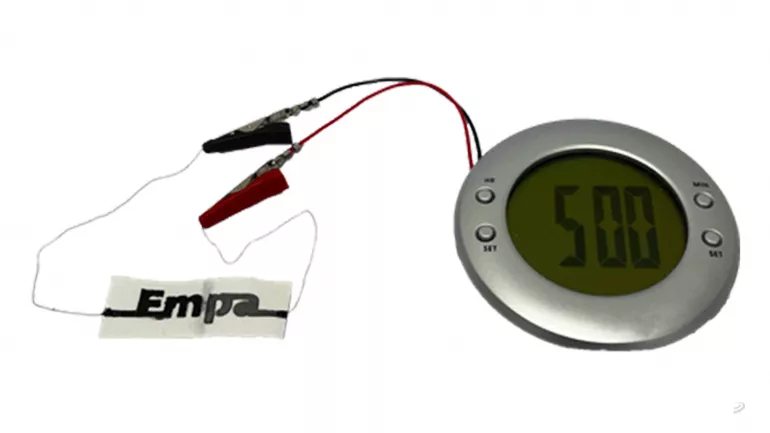
To be excruciatingly precise, we tell you that the EMPA prototype is capable of producing 150 µW/cm² at 0.5 milliamps to achieve a voltage of 0.2 volts. It is not much, indeed, but it is enough to run self-diagnostic devices for diabetics, maintain the temperature of vaccines or even to power an alarm clock. To understand how these batteries work, check out the list of “ingredients” and scroll back down, which we tell you how it all comes together, according to the EMPA.
“The battery […] Is made with at least a one square centimeter cell that is composed of a rectangular sheet of paper. printed with three inks. The salt, which is nothing more than common salt (sodium chloride), is spread along the paper strip, and the wax is impregnated on one of the short sides. On one side is printed an ink composed of graphite flakes which act as the positive pole of the battery. (the cathode), while the other is printed by the other ink with zinc powderwhich acts as the negative pole (the anode). A third ink containing graphite flakes and carbon black is applied on both sides of the sheet, over the other inks. The latter constitutes the current collectors that connect the poles to two wires attached to the ends of the cell”.
“By adding a small amount of waterthe salts impregnated in the paper dissolve, releasing charged ions and causing the electrolyte to conduct them. These ions activate the battery as they are dispersed through the paper, thereby oxidizing the zinc in the ink, which releases electrons. When the circuit is closed (externally), electrons are transferred from the zinc anode to the zinc anode. through the graphite and carbon ink.The graphite ink, the wires and the device, to the graphite cathode. This reduces the ambient oxygen. Thus, this redox reaction generates an electric current. capable of powering an external electronic device“.
Well, now you will understand why Gustav Nyström and his team have been working on this kind of biodegradable battery for 10 years now. We can only dream of a world in which we are not dependent on lithium, cobalt or aluminum batteriesIn which the batteries are made of printed paper that are self-powered by water to operate.


